In brief
A machine can approach a goal through correction signals that reduce its error 5. Rosenblueth, Wiener and Bigelow distinguish this feedback-controlled purpose from behavior without ongoing correction, and distinguish prediction from following a current source 68. Their classification gives us a vocabulary for examining goal pursuit; choosing a safe goal remains a separate question.
Why this paper matters today
Goal-directed behavior can be studied through a mechanism: a goal, signals about error, and corrective actions. Later safety work asks further questions about that mechanism, including whether people can intervene in time and whether an agent has incentives to accept intervention. These examples connect the essay’s vocabulary to later concerns; they do not imply that the original essay tested modern AI or solved alignment.
-
Some Moral and Technical Consequences of Automation (1960)
Wiener later treats human intervention as feedback and argues that a machine operating faster than people can understand may become difficult to stop in time. This extends the feedback perspective toward the timing and information needed for effective oversight.
-
The Off-Switch Game (2016)
Hadfield-Menell and colleagues model when a goal-directed agent has an incentive to preserve human shutdown control. Their formal game considers uncertainty about the objective and human actions as evidence. It is related later research on goal pursuit and intervention, rather than a replication of the 1943 classification.
1,577 citations indexed by OpenAlex · Checked
OpenAlex record for the original January 1943 Philosophy of Science article, verified by title, all three authors and DOI 10.1086/286788; index coverage is not a complete measure of influence.
Citation totals reflect index coverage and attention, not endorsement or scientific correctness.
Key points
A corrected route can lead to the wrong room
Imagine a delivery robot adjusting its route around a person while carrying a package to the wrong room. This hypothetical example separates competent movement from a useful outcome. In January 1943, Rosenblueth, Wiener and Bigelow set out to classify behavior and clarify the concept of purpose 1. Their approach helps us describe what a machine is doing before asking whether its destination serves the person relying on it.
What counts as purpose
The authors define purposeful behavior as an act interpreted as directed toward a goal: a final relation to another object or event 2. A clock illustrates their distinction between a designer’s purpose and a machine’s behavior. Although built for a purpose, its repeating motion does not approach a specific final condition, so the authors classify it as non-purposeful 3. The question concerns how the behavior relates to a goal, rather than simply why someone built the device.
How feedback corrects error
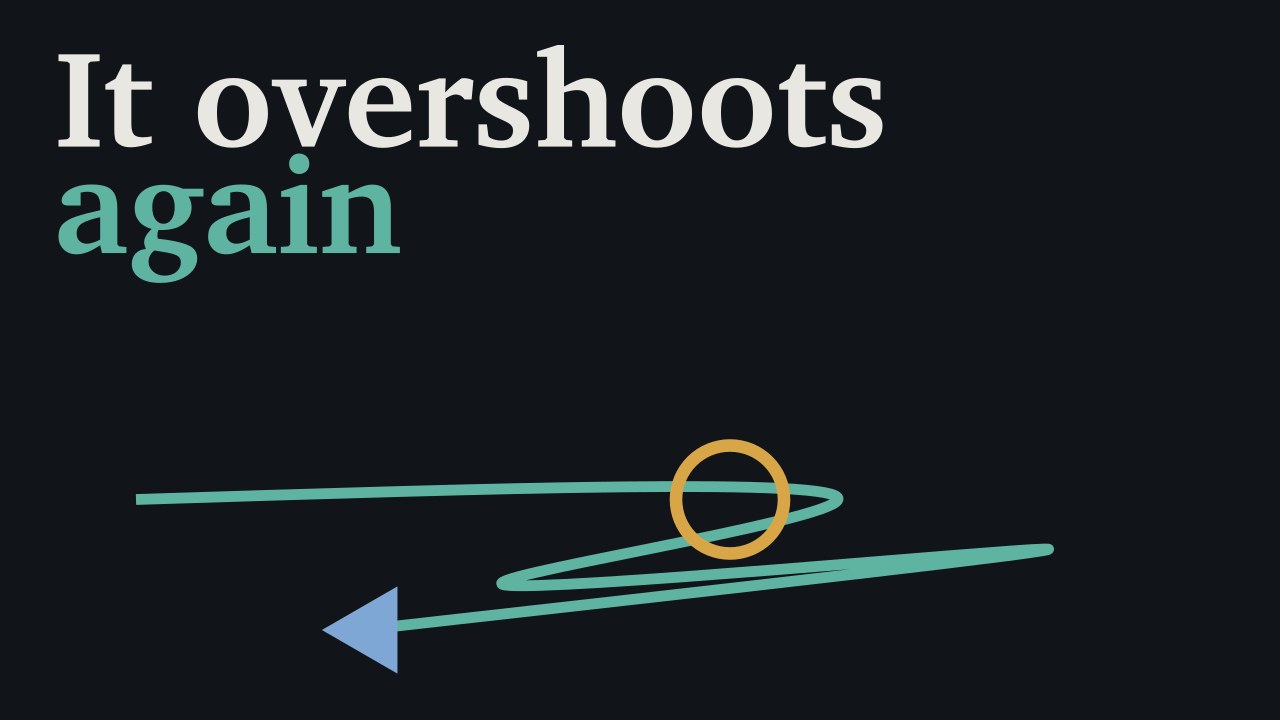
Negative feedback controls behavior through its margin of error relative to a goal 5. Signals from the goal restrict movement that would otherwise go beyond it. The authors also allow purposeful behavior without fresh goal signals modifying activity during the movement 6. In their hypothetical light-guided machine, repeated overshooting produces growing oscillations and a missed goal 7. A corrective loop must therefore be examined through the behavior it produces, including how it can fail.
What prediction adds
Feedback-controlled behavior may follow a current source or anticipate a future position 8. The authors illustrate prediction with a cat moving toward where a running mouse is going 9. They use teleology to mean purposeful behavior controlled by negative feedback: correction guided by the difference between the present state and the final state interpreted as the purpose 10. This gives purpose a description in terms of an observable corrective mechanism.
Key findings
Each finding is labelled with its status in the paper: what was measured, what was proven, and what the authors infer.
- Definition
Purposeful behavior is interpreted as directed toward a goal condition, rather than defined by the reason someone built a machine 23.
- Definition
Negative feedback uses error relative to a goal to restrict outputs that would otherwise go beyond it 5.
- Hypothesis
In the authors’ imagined light-guided machine, repeated overshooting creates growing oscillations and misses the goal 7.
- Definition
Predictive behavior anticipates a future position, illustrated by a cat pursuing a running mouse 89.
Limitations and context
- Stated by the authors
The authors acknowledge that their broad definition of purpose is vague and operationally largely meaningless, while retaining it as useful 4.
- Editorial context
This is a conceptual classification with illustrative examples and hypotheses, rather than an experimental assessment of modern AI safety.
Read the essay as a way to distinguish a goal, ongoing correction and prediction, rather than as a method for choosing goals that benefit people 258. The delivery robot is our editorial illustration, not a system the authors tested. Evidence page numbers refer to the archive.org retypeset PDF linked above, whose pagination differs from the original journal article.
Evidence from the paper
Numbered citations above point here. Quotations are verbatim from the published version of the paper.
-
1
Method
The essay aims to define the behavioristic study of natural events, classify behavior, and stress the importance of purpose.
“This essay has two goals. The first is to de- fine the behavioristic study of natural events and to classify behavior. The second is to stress the importance of the concept of pur- pose.”Page 1
-
2
Definition
Purposeful active behavior can be interpreted as directed toward a goal, a final relation in time or space to another object or event.
“The term purposeful is meant to denote that the act or behavior may be interpreted as directed to the attainment of a goal — i.e., to a final condition in which the behaving ob- ject reaches a definite correlation in time or in space with respect to another object or event.”Page 1
-
3
Authors' interpretation
The authors reject the view that every machine is purposeful: a clock can be designed for a purpose without its behavior approaching a specific final condition.
“Then may be considered devices such as a clock, designed, it is true, with a purpose, but having a performance which, although orderly, is not purposeful — i.e., there is no specific final condition toward which the movement of the clock strives.”Page 2
-
4
Stated limitation
The authors acknowledge that their definition of purposeful behavior is relatively vague and operationally largely meaningless, but retain purpose as a useful concept.
“It is apparent from these considerations that although the definition of purposeful be- havior is relatively vague, and hence oper- ationally largely meaningless, the concept of purpose is useful and should, therefore, be re- tained.”Page 2
-
5
Definition
The paper uses negative feedback to mean control by the margin of error relative to a goal, with goal signals restricting outputs that would go beyond it.
“The term feed-back is also employed in a more restricted sense to signify that the behavior of an object is controlled by the margin of error at which the object stands at a given time with refer- ence to a relatively specific goal. The feed-back is then negative, that is,”Page 2
“the signals from the goal are used to restrict outputs which would otherwise go beyond the goal.”Page 2
-
6
Definition
Non-feedback behavior lacks goal signals modifying activity during the behavior; the authors still consider purposeful behavior to need goal signals at some time.
“All purposeful behavior may be considered to require negative feed-back. If a goal is to be attained, some signals from the goal are nec- essary at some time to direct the behavior.”Page 2
“By non-feed-back behavior is meant that in which there are no signals from the goal which mod- ify the activity of the object in the course of the behavior.”Page 2
-
7
Hypothesis
In the paper’s hypothetical light-guided machine, repeated overshooting leads to growing oscillations and missing the goal.
“Suppose further that the machine overshoots seriously when it follows a move- ment of the goal in a certain direction; an even stronger stimulus will then be delivered which will turn the machine in the opposite direction. If that movement again overshoots a series of increasingly larger oscillations will ensue and the machine will miss the goal.”Page 2
-
8
Definition
Feedback purposeful behavior can be predictive or non-predictive; the authors describe an amoeba following a source as non-predictive.
“Feed-back purposeful behavior may again be subdivided. It may be extrapolative (pre- dictive), or it may be non-extrapolative (non- predictive). The reactions of unicellular organ- isms known as tropisms are examples of non- predictive performances. The amoeba merely follows the source to which it reacts; there is no evidence that it extrapolates the path of a moving source.”Page 3
-
9
Background
The authors illustrate prediction with a cat pursuing a running mouse by moving toward its extrapolated future position.
“A cat start- ing to pursue a running mouse does not run directly toward the region where the mouse is at any given time, but moves toward an extrap- olated future position.”Page 3
-
10
Definition
Teleological behavior is restricted to purposeful reactions controlled by error: the difference between current state and the final state interpreted as purpose.
“We have restricted the connotation of teleo- logical behavior by applying this designation only to purposeful reactions which are con- trolled by the error of the reaction — i.e., by the difference between the state of the behav- ing object at any time and the final state inter- preted as”Page 5
“the purpose. Teleological behavior thus becomes synonymous with behavior con- trolled by negative feedback, and gains there- fore in precision by a sufficiently restricted connotation.”Page 5
References
- Behavior, Purpose and Teleology — the original paper